There is a familiar frustration in most engineering organizations: test automation that nobody except its original author can understand. Scripts filled with locator strings, click-and-wait chains, and brittle selectors that break the moment a developer renames a button. Tests that document the implementation, not the business intent. Tests that have to be rewritten from scratch when the UI changes, even when the underlying logic didn’t move an inch.
After more than 30 years of building and optimizing test automation for enterprises — from Fortune 500 companies to government agencies — we’ve learned that this isn’t a tooling problem. It’s a design problem. And the solution is a disciplined, layered architecture called Keyword-Driven Testing.
What Keyword-Driven Testing Actually Is
The core rule of keyword-driven design is deceptively simple: test cases should describe what a business scenario does, not how the technology executes it.
A test case should read like a business process — clear, human-readable, and free of technical implementation noise. Consider a standard e-commerce checkout flow. In a keyword-driven framework, that test case looks like this:
- LoginAsStandardUser
- AddProductToCart
- CheckoutCurrentOrder
- VerifyOrderCompleted
- LogoutStandardUser
Notice what’s absent: no XPath selectors, no findElement() calls, no wait commands, no hardcoded field IDs. The test case tells you exactly what the user does in that session, at the same level of abstraction a business analyst or product owner would use. This is entirely by design.
The Five-Layer Architecture
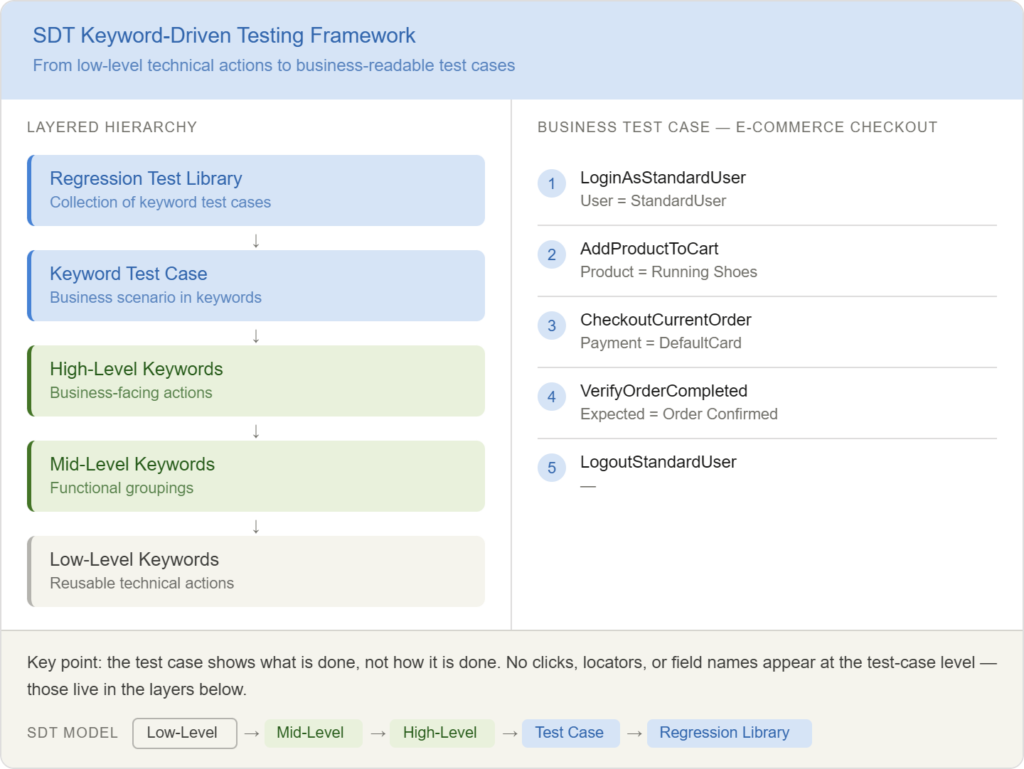
What enables this readability is a five-layer hierarchy — SDT’s Keyword Framework — that separates business intent from technical execution at every level of the stack.
At the top sits the Regression Test Library: a curated collection of test cases that together validate the critical business flows of your application. Below it, each Keyword Test Case represents a single business scenario composed exclusively of high-level keywords. That test case layer doesn’t know — and doesn’t need to know — what actually happens when LoginAsStandardUser is invoked.
The next layer handles that. High-Level Keywords are reusable, business-facing actions that assemble several functional steps. LoginAsStandardUser, for example, is built from OpenStoreApplication, EnterLoginCredentials, SubmitLogin, and ConfirmLoginSuccess. Below that, Mid-Level Keywords group the specific technical interactions within each of those steps. And at the foundation, Low-Level Keywords represent individual atomic actions: StartBrowser, NavigateToUrl, SetText, PressButton, VerifyTextValue.
This architecture means that when the login UI changes — the button moves, the form field gets renamed, the page structure is rebuilt — only the low-level keywords need to be updated. The test cases at the top remain stable. The business logic stays verified. And the return on your test automation investment compounds across every release cycle rather than eroding with each sprint.
Why This Matters to Technology Leaders
For CIOs and CTOs, the business value of this architecture shows up in three concrete areas.
The first is maintainability. In traditional UI-level scripting, a front-end redesign can invalidate dozens or hundreds of test scripts simultaneously. With keyword-driven layering, the blast radius of a UI change is contained to the lowest layer. The rest of the library survives intact and continues to deliver value without rework.
The second is organizational readability. When a QA engineer, product manager, or business stakeholder can open a test case and immediately understand what business flow it validates, the entire quality organization benefits. Defect triage becomes faster. Regression scope becomes easier to communicate upward. Test coverage becomes a shared language across technical and non-technical teams — and that shared language is rare and valuable.
The third is ROI longevity. Test assets built on a keyword-driven framework have a significantly longer useful life than UI-scripted equivalents. SDT has seen clients achieve automated regression ROI of approximately 330%, with test libraries that remain accurate and maintainable across multiple product releases rather than requiring wholesale rebuilds.
The Ownership Advantage
One underappreciated benefit of keyword-driven design is that it creates a clean, sustainable division of labor within the testing organization. The high-level test case layer can be designed and maintained by QA professionals who understand business logic but may not have deep technical depth. The lower layers — where locators, protocols, and API calls live — require a different skill set: technical fluency with frameworks, testing tools, and integration patterns.
Keyword design separates these concerns naturally, which means you can staff each layer with the right people without requiring every tester to also be a software engineer.
Building It Right the First Time
Establishing a keyword-driven framework from scratch requires architectural expertise that many internal teams don’t have the bandwidth or specialized experience to develop in-house. SDT designs and implements these frameworks for organizations across industries — from the initial architecture and keyword library design through to CI/CD pipeline integration and team knowledge transfer. The goal is always the same: build the framework correctly once, with test assets that your team can own and scale going forward.
The Bottom Line
The test automation most organizations have today describes how software gets clicked through. The test automation that serves organizations well over time describes what the business does — and keeps the implementation details where they belong, in the layers below.
If your team is dealing with brittle tests, mounting maintenance overhead, or automation libraries that only one person truly understands, the architecture is the issue. Keyword-driven testing is the fix.