The Architecture of Readable Test Automation: Why Keyword-Driven Testing Changes Everything
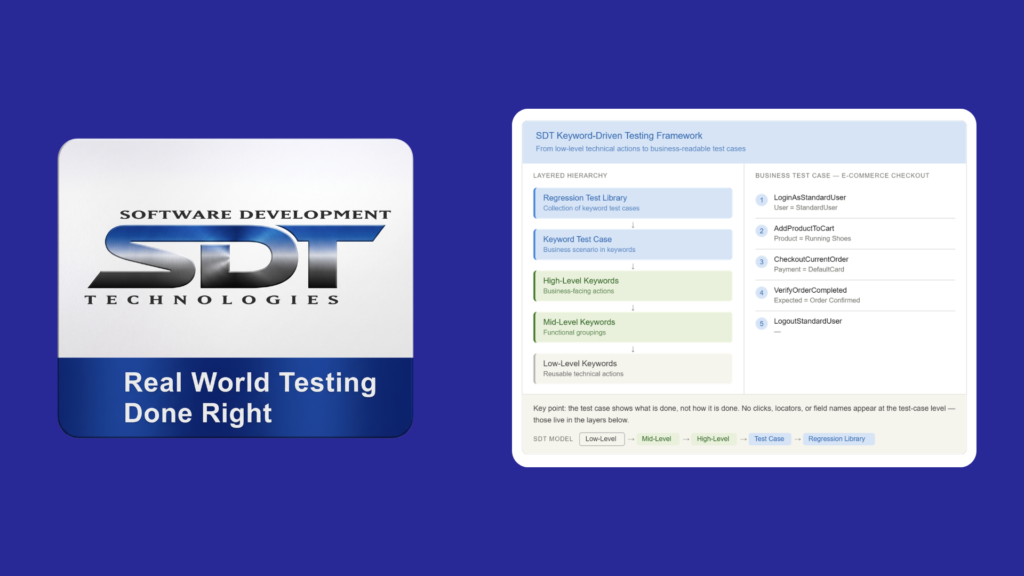
There is a familiar frustration in most engineering organizations: test automation that nobody except its original author can understand. Scripts filled with locator strings, click-and-wait chains, and brittle selectors that break the moment a developer renames a button. Tests that document the implementation, not the business intent. Tests that have to be rewritten from scratch when the UI changes, even when the underlying logic didn’t move an inch. After more than 30 years of building and optimizing test automation for enterprises — from Fortune 500 companies to government agencies — we’ve learned that this isn’t a tooling problem. It’s a design problem. And the solution is a disciplined, layered architecture called Keyword-Driven Testing. What Keyword-Driven Testing Actually Is The core rule of keyword-driven design is deceptively simple: test cases should describe what a business scenario does, not how the technology executes it. A test case should read like a business process — clear, human-readable, and free of technical implementation noise. Consider a standard e-commerce checkout flow. In a keyword-driven framework, that test case looks like this: Notice what’s absent: no XPath selectors, no findElement() calls, no wait commands, no hardcoded field IDs. The test case tells you exactly what the user does in that session, at the same level of abstraction a business analyst or product owner would use. This is entirely by design. The Five-Layer Architecture What enables this readability is a five-layer hierarchy — SDT’s Keyword Framework — that separates business intent from technical execution at every level of the stack. At the top sits the Regression Test Library: a curated collection of test cases that together validate the critical business flows of your application. Below it, each Keyword Test Case represents a single business scenario composed exclusively of high-level keywords. That test case layer doesn’t know — and doesn’t need to know — what actually happens when LoginAsStandardUser is invoked. The next layer handles that. High-Level Keywords are reusable, business-facing actions that assemble several functional steps. LoginAsStandardUser, for example, is built from OpenStoreApplication, EnterLoginCredentials, SubmitLogin, and ConfirmLoginSuccess. Below that, Mid-Level Keywords group the specific technical interactions within each of those steps. And at the foundation, Low-Level Keywords represent individual atomic actions: StartBrowser, NavigateToUrl, SetText, PressButton, VerifyTextValue. This architecture means that when the login UI changes — the button moves, the form field gets renamed, the page structure is rebuilt — only the low-level keywords need to be updated. The test cases at the top remain stable. The business logic stays verified. And the return on your test automation investment compounds across every release cycle rather than eroding with each sprint. Why This Matters to Technology Leaders For CIOs and CTOs, the business value of this architecture shows up in three concrete areas. The first is maintainability. In traditional UI-level scripting, a front-end redesign can invalidate dozens or hundreds of test scripts simultaneously. With keyword-driven layering, the blast radius of a UI change is contained to the lowest layer. The rest of the library survives intact and continues to deliver value without rework. The second is organizational readability. When a QA engineer, product manager, or business stakeholder can open a test case and immediately understand what business flow it validates, the entire quality organization benefits. Defect triage becomes faster. Regression scope becomes easier to communicate upward. Test coverage becomes a shared language across technical and non-technical teams — and that shared language is rare and valuable. The third is ROI longevity. Test assets built on a keyword-driven framework have a significantly longer useful life than UI-scripted equivalents. SDT has seen clients achieve automated regression ROI of approximately 330%, with test libraries that remain accurate and maintainable across multiple product releases rather than requiring wholesale rebuilds. The Ownership Advantage One underappreciated benefit of keyword-driven design is that it creates a clean, sustainable division of labor within the testing organization. The high-level test case layer can be designed and maintained by QA professionals who understand business logic but may not have deep technical depth. The lower layers — where locators, protocols, and API calls live — require a different skill set: technical fluency with frameworks, testing tools, and integration patterns. Keyword design separates these concerns naturally, which means you can staff each layer with the right people without requiring every tester to also be a software engineer. Building It Right the First Time Establishing a keyword-driven framework from scratch requires architectural expertise that many internal teams don’t have the bandwidth or specialized experience to develop in-house. SDT designs and implements these frameworks for organizations across industries — from the initial architecture and keyword library design through to CI/CD pipeline integration and team knowledge transfer. The goal is always the same: build the framework correctly once, with test assets that your team can own and scale going forward. The Bottom Line The test automation most organizations have today describes how software gets clicked through. The test automation that serves organizations well over time describes what the business does — and keeps the implementation details where they belong, in the layers below. If your team is dealing with brittle tests, mounting maintenance overhead, or automation libraries that only one person truly understands, the architecture is the issue. Keyword-driven testing is the fix.
Why API Testing Is the Most Important Investment Your Tech Organization Isn’t Making

After 25 years of leading software engineering projects at organizations ranging from ambitious startups to Fortune 200 enterprises, I’ve arrived at a conclusion that surprises most of the technology leaders I meet: API testing is more important than User Interface testing. And most organizations are dramatically underinvesting in it. That statement deserves context. I am not dismissing UI testing. It matters. But in a world where your applications are increasingly defined by how they communicate — with each other, with third-party services, with IoT devices, with microservices buried several layers deep in your infrastructure — the layer where that communication actually happens is the layer you should be testing most rigorously. And for the majority of enterprises I’ve worked with, it isn’t. This isn’t a technical footnote. It’s a strategic blind spot that carries real business risk. For the CIOs, CTOs, and CXOs reading this: what follows is an argument for why closing the API testing gap is one of the highest-leverage decisions your organization can make right now. Your Applications Live and Die at the API Layer To understand why API testing is so critical, it helps to think clearly about what an API actually does. An Application Program Interface is the common language your applications use to communicate with each other. When your mobile banking app talks to your core banking system, that’s an API. When your e-commerce platform processes a payment, that’s an API. When your healthcare portal retrieves patient records from a connected system, that’s an API. This is the actual nervous system of your digital business. And yet, most testing investment has historically been concentrated at the User Interface level — the outermost layer of your application. Testing there is important, but it is inefficient. UI tests are slow to execute, brittle in the face of change, and expensive to maintain. More critically, they often miss the defects that matter most, because those defects live deeper in the stack. When an API hasn’t been adequately tested and fails in production, the consequences are not abstract. Quality breaks down. Privacy is compromised. Security vulnerabilities are exposed. And in many cases, the customer ends up doing the testing for you — a scenario no technology leader can afford. The Business Case Is Urgent and Multidimensional The imperative for API testing isn’t driven by one trend — it’s driven by several converging forces that every C-suite leader should recognize. The Internet of Things has eliminated the traditional interface. IoT devices typically don’t have a UI in any conventional sense. They communicate purely through APIs. If your organization is investing in connected devices — in manufacturing, healthcare, logistics, or retail — API testing isn’t optional. It’s the only testing that applies. Hackers attack at the API level. Penetration attacks, injection exploits, and data exfiltration almost universally target APIs, not user interfaces. Rigorous API security testing — including malicious attack simulation — is your most direct line of defense. UI testing provides no meaningful protection here. Agile and DevOps demand speed, and API tests deliver it. In a CI/CD environment, long-running UI test suites create bottlenecks that erode your competitive advantage. API tests can be designed earlier in the development cycle, execute far faster than UI tests, and integrate cleanly into your automated pipeline. Organizations that prioritize API testing are able to release with confidence, at speed, without sacrificing coverage. API tests have a longer shelf life. This is a point that doesn’t get enough attention. UI tests are notoriously fragile — a redesign of the front-end interface can invalidate an entire test library overnight. API tests, by contrast, are tied to the underlying behavior of your system, not its visual presentation. That means your investment in API testing compounds over time rather than depreciating with every sprint. The Ownership Problem Nobody Wants to Talk About Here’s one of the most revealing data points I’ve encountered in 25 years of this work. In a recent industry study, 80% of developers said that the test organization is responsible for API testing. At the same time, 70% of testers said that the development organization is responsible for API testing. The result is a gap where everyone assumes someone else has it covered — and almost no one does. This is not a technology problem. It is a governance and organizational design problem, and it’s one that technology leaders must solve at the strategic level. The reality is that developers are often too close to the code and too overextended to own API testing comprehensively. Meanwhile, many QA teams lack the technical depth that sophisticated API testing demands — these aren’t manual click-through testers; they need to understand protocols, message formats, authentication schemes, and integration patterns. The gap between what’s needed and what’s resourced is significant in most organizations. The most practical path forward, in my experience, is engaging a specialized third-party partner who can bring both the technical depth and the dedicated focus that internal teams struggle to maintain. A partner experienced in API testing can establish the framework, build the test library, integrate it into your pipeline, and position your internal team to sustain it. At SDT, this has been the model that’s worked at scale — from document processing platforms to embedded systems to financial services infrastructure — and across companies of every size. What a Mature API Testing Practice Actually Looks Like For technology leaders evaluating where their organization stands, here is a clear picture of what a mature API testing capability should include: It should cover the full spectrum of API types: RESTful services, SOAP-based web services, microservices (including Kafka, RabbitMQ, and WebSocket-based architectures), messaging protocols, and database interfaces. “API testing” that only covers REST is a partial solution at best. It should be automated. Manual API exploration tools like Postman are useful for discovery and early-stage design, but they cannot meet the demands of a modern Agile environment. A keyword-driven automation framework — one that enables reusable, maintainable test assets integrated directly into your CI/CD pipeline
The 2026 QA Paradox: Why More AI-Generated Code Requires More Human Strategy

As we move through 2026, the software industry has hit a fascinating—and challenging—inflection point. Generative AI is now responsible for over 50% of all initial code commits in enterprise environments. Development speed has never been higher, yet for many organizations, time-to-market is actually slowing down. This is the 2026 QA Paradox: When you automate the “writing” of code without a corresponding evolution in the “testing” of that code, you don’t get a faster release—you get a bottleneck of technical debt and “noisy” test results. The Rise of Agentic Testing The biggest news in the testing world this year is the transition from static automation scripts to Autonomous Testing Agents. Unlike traditional scripts that break when a UI element moves, 2026’s “Agentic” tools use computer vision and self-healing algorithms to adapt in real-time. However, industry data shows a growing “Trust Gap.” While 82% of tech leaders view AI as essential for QA, nearly 73% of testers still don’t trust AI-generated test outputs without human verification. The Signal vs. Noise Problem At Software Development Technologies (SDT), we are seeing this play out across every sector. AI tools are great at generating volume, but they are often poor at identifying intent. Why “Human-in-the-Loop” is the New Gold Standard The industry news for 2026 isn’t that AI is replacing testers; it’s that the role of the tester is “gentrifying” into a high-level Quality Architect. In this new landscape, success is no longer measured by how many tests you run, but by Risk Mitigation Efficiency. Leading firms are moving away from “checking for correctness” (did the button work?) toward “evaluating behavior” (did the AI-driven recommendation make sense for the user?). What This Means for Your 2026 Strategy If your organization is feeling the pressure of AI-accelerated development, the solution isn’t just “more tools.” It’s a structural transformation: The SDT Takeaway At SDT, our “Real World” methodology was built for exactly this kind of complexity. Whether it’s through our 3G Test Automation or our Test Transformation Consulting, we help you turn AI from a source of noise into a source of competitive advantage. In a world of AI-generated code, human-led strategy is the only thing that guarantees quality.
The $10,000 Typo: Why Technical Reviews are Your Best Defense Against Budget Creep

In the world of software development, there is a famous rule of thumb: a defect that costs $100 to fix during the requirements phase will cost $1,000 to fix during development and over $10,000 if it reaches production. Despite this, many teams skip the most effective way to catch these defects early: Technical Reviews. At Software Development Technologies (SDT), we’ve integrated “TRIPT” (Technical Reviews and Inspections Process and Training) into our core methodology because we’ve seen it happen time and again—teams spend millions on automation tools to find bugs that should have been caught with a simple 30-minute peer review weeks earlier. 1. It’s Not “Just Another Meeting” The biggest hurdle to successful reviews is the “meeting fatigue” culture. Most developers view code reviews as a bureaucratic hurdle. However, a structured Technical Review Methodology is actually a time-saver. When done correctly—using SDT’s proven templates and checklists—reviews act as a “Force Multiplier.” They don’t just find bugs; they ensure architectural consistency, facilitate knowledge transfer, and prevent the “hero developer” syndrome where only one person knows how a critical system works. 2. Shifting Left: Validation vs. Verification Most testing happens at the end of the cycle (Verification). Technical reviews allow you to perform Validation at the beginning. By reviewing requirements, design documents, and test plans before a single line of code is written, you ensure that the team isn’t just “building the thing right,” but is “building the right thing.” 3. The ROI of the “Quiet Phase” The most successful projects we’ve consulted on at SDT share a common trait: they have a high “Review-to-Code” ratio. 4. How to Implement a Culture of Quality If your team is struggling with “death-march” release cycles, the answer isn’t usually more testers—it’s better reviews. SDT provides specialized training to help organizations implement: Conclusion: Don’t Wait for the Bug Report Testing is vital, but it’s the final safety net. To build truly world-class software, you need to stop bugs before they are born. By implementing a rigorous Technical Review process, you aren’t just improving quality—you’re protecting your bottom line.
Beyond Outsourcing: The Strategic Case for “Rightsourcing” Your QA

For decades, the math behind software testing was simple: find the lowest cost-per-hour, offshore the work, and wait for the results. But as software complexity has skyrocketed, the hidden costs of traditional outsourcing—communication silos, time-zone lag, and fluctuating quality—have become impossible to ignore. At Software Development Technologies (SDT), we believe the industry is moving toward a more nuanced model: Rightsourcing: What is Rightsourcing? Unlike outsourcing, which is often a “hands-off” transfer of tasks, Rightsourcing is the strategic alignment of internal expertise with specialized external support. It isn’t about replacing your team; it’s about optimizing your Test Transformation by putting the right tasks in the right hands. The Three Pillars of a Rightsourced Strategy 1. Maintaining Intellectual Property (IP) When you outsource your entire testing department, your institutional knowledge leaves with the vendor. Rightsourcing ensures that your core testing strategy and product knowledge stay in-house. SDT works as an extension of your team, building frameworks and processes that you own, ensuring long-term stability. 2. Specialized Talent on Demand Not every project requires a full-time automation architect or a performance testing expert year-round. Rightsourcing allows you to inject high-level expertise into your pipeline exactly when you need it—such as during a Development and Test Assessment or a major platform migration—without the overhead of permanent senior hires. 3. Bridging the “Culture Gap” Traditional outsourcing often suffers from a “check-the-box” mentality. Rightsourcing focuses on Software Testing in the Real World. By aligning external consultants with your specific business goals and company culture, the testing process becomes a value-driver rather than a bottleneck. The ROI of Doing it Right When you stop chasing the lowest hourly rate and start chasing the highest process efficiency, the results are measurable: Is Your Team Optimized? The goal of testing isn’t just to find bugs; it’s to provide the confidence to ship. If your current testing model feels disconnected from your development goals, it might be time to stop outsourcing and start Rightsourcing.
The Automation Trap: Why 70% of Test Automation Projects Fail (and How to Avoid It)

In the modern software development lifecycle, “speed to market” is the ultimate metric. To keep up, organizations rush to automate their testing suites, viewing it as a “silver bullet” that will magically reduce costs and eliminate bugs. Yet, industry data suggests a sobering reality: nearly 70% of test automation initiatives fail to meet their original goals. They often become “shelf-ware”—expensive, brittle scripts that are eventually abandoned because they require more time to maintain than they save in execution. At Software Development Technologies (SDT), we’ve spent decades helping organizations move past the “tool-first” mentality. If your automation efforts are stalling, you are likely falling into one of these three common traps. 1. The Tool-First Fallacy Many companies start their automation journey by asking, “Which tool should we buy?” This is the equivalent of buying a high-end racing car before you’ve built a road or learned how to drive. Automation is not a product; it is a specialized form of software development. Without a foundational Test Design Methodology, even the most expensive tool will only help you execute bad tests faster. Effective automation requires a strategy that is tool-agnostic, focusing on the architecture of the test suite rather than the features of the software driving it. 2. The Maintenance Nightmare (Brittle Scripts) The most common cause of automation failure is “brittleness.” If a minor UI change—like moving a button or renaming a field—causes 50% of your automated tests to fail, your ROI is dead. At SDT, we advocate for a 3G (Third Generation) Test Automation System. Unlike 1G (simple record/playback) or 2G (basic data-driven) approaches, 3G automation focuses on a framework-based approach. By separating the test logic from the physical interface, you create a modular system where changes to the application only require a single update in the framework, rather than a rewrite of hundreds of scripts. 3. Ignoring the “Real World” Context Automation is often treated as a task for junior testers or an “extra” job for developers. However, software testing in the real world involves complex dependencies, legacy data, and shifting requirements. Successful automation requires: The Path Forward: Strategy Over Scripts To avoid the automation trap, organizations must shift their focus from “writing scripts” to “building a transformation.” This involves a rigorous assessment of current processes, professional training for the engineering team, and the implementation of a robust, scalable framework. Automated testing should be an asset that grows in value over time, providing the confidence your team needs to deploy faster. If your current automation suite feels more like a liability than an asset, it may be time to rethink the methodology behind the machine.
The Testing Engagement That Leaves You Dependent Wasn’t Really an Investment

Why knowledge transfer has to be a design goal from day one — not a handoff at the end There is a particular kind of frustration that engineering leaders know well, and it usually happens about three months after a consulting engagement ends. The testing infrastructure that was built looks impressive. The coverage numbers were good. The reports during the engagement showed real progress. Then the consultants leave, the internal team tries to run the framework without them, and it becomes clear that something essential went with them — not maliciously, not through anyone’s negligence, just because the knowledge was never actually transferred. It lived in the heads of the people who built it, embedded in undocumented decisions, tool configurations that made sense to the people who set them up, and test architectures that nobody on the internal team fully understands. Six months later the framework is deteriorating. A year later it’s half-abandoned. The engagement produced a dependency, not a capability. This is not an accident. Ongoing dependency is a commercially rational outcome for most consulting firms. If your client can run the system without you, the engagement ends. If they can’t, it continues — or you come back. The incentive structure of most testing engagements points directly away from knowledge transfer. Understanding that dynamic is the first step toward buying engagements differently. What Testing Knowledge Actually Consists Of The challenge with testing knowledge is that so much of it is invisible until it’s gone. When a senior automation engineer leaves — whether they’re a consultant departing at the end of an engagement or an internal employee who found another job — they take with them a specific combination of things that are genuinely hard to document after the fact. They know why the framework is structured the way it is. They understand which design decisions were deliberate and which were workarounds for constraints that no longer exist. They know the parts of the automation library that are solid and the parts that are fragile. They know the test data dependencies, the environment quirks, the timing issues that were worked around, the edge cases that were explicitly scoped out. None of this appears in the test cases themselves. It exists in memory. This is why the composition of the automation suite matters so much for survivability. A framework built entirely on custom scripts, where knowledge is embedded in code that only the author fully understands, is brittle by definition. When the author leaves, the code remains but the reasoning behind it doesn’t. Maintenance becomes archaeology — reverse-engineering intent from implementation, which is expensive and error-prone. A framework built on a documented, structured methodology — with test cases written in readable business language, with automation logic separated cleanly from test design, with roles that different people can take on independently — survives personnel changes much better. Not because the knowledge disappears any less, but because less of the critical knowledge is stored in individual people rather than in the structure of the system itself. The Shadowing Problem The conventional approach to knowledge transfer in consulting engagements is documentation plus handoff. The consultants write things down toward the end of the project, spend a few days walking the internal team through what was built, and then leave. The documentation is usually too high-level to be operationally useful, the walk-through covers what was built but not why, and the internal team spends the next several months discovering what wasn’t written down. The more effective model runs knowledge transfer in parallel with delivery from the beginning — not as a handoff phase at the end, but as a continuous practice throughout. The first phase is straightforward: internal team members shadow the senior consultants while work is happening. They’re present for design decisions, they hear the reasoning behind architectural choices, they see how problems get diagnosed and resolved in real time. This is not passive observation — it’s deliberate exposure to the thinking process that produces the outputs, not just the outputs themselves. The second phase flips the model. Internal team members begin doing the work themselves while senior consultants observe, provide correction, and increasingly step back. This reverse shadowing is where the transfer actually happens and where gaps become visible. A team member who watched something done correctly for three months will often discover, when they try to do it themselves, that they understood the mechanics but missed something about the judgment involved. That gap is much better discovered while senior support is still present than after the engagement has ended. The explicit goal of this model — stated as a requirement, not a hope — is that the client’s team is prepared to run the system independently before the engagement concludes. Not mostly prepared. Not prepared with a support contract backstop. Actually capable of operating, maintaining, and extending what was built without ongoing consultant involvement. At MMC Networks, SDT was engaged specifically to implement a test automation solution, staff the project during the build, and then transfer the technology and process knowledge to the new QA staff as they came on board. The transfer wasn’t an afterthought — it was part of the stated scope from the beginning. The engagement was defined as complete when the internal team could run the system, not when the system was built. At PepsiCo, one of the explicit goals established at the outset was “the ability for PepsiCo to be self-sufficient running test centers.” Self-sufficiency wasn’t a nice-to-have — it was a named success criterion. Building something that required continued outside involvement to operate would have been a failure against that goal, not a success. What You Should Ask Before Starting Any Engagement The way to evaluate whether a testing engagement is structured for your independence or for ongoing dependency is to ask a specific set of questions before the work begins. How will knowledge be transferred during the engagement, not at the end of it? If the answer involves documentation and a handoff session, the
Before You Buy Another Testing Tool, Do This First

Most testing problems are misdiagnosed. An honest process assessment finds the real issue — and often it’s not what anyone expected. There’s a pattern that plays out in testing organizations with remarkable consistency. Something is clearly wrong — releases are slipping, bugs are reaching production, the team feels like they’re always behind. Leadership makes a diagnosis: we need better tools, or more headcount, or a different CI/CD setup. Money gets spent. Things improve marginally, then drift back. Six months later, the same conversation happens again with a different culprit in the title role. The diagnosis is usually wrong. Not because the people making it aren’t smart, but because the symptoms of a broken testing process look almost identical regardless of what’s actually causing the problem. Late defects, slow releases, brittle automation, coverage gaps — these appear whether the real issue is organizational structure, tool mismatch, process inconsistency, or something no one has bothered to look at properly. The expensive mistake most teams make is skipping the diagnostic step entirely and going straight to solutions. The cheaper, more effective alternative is to find out what’s actually broken before deciding how to fix it. What a Real Assessment Looks Like A process assessment isn’t a sales conversation or a vendor demo disguised as an evaluation. Done properly, it’s an unbiased, structured examination of a testing organization’s methods, tools, practices, organizational structure, and environment — with the explicit goal of identifying the highest-priority areas for improvement and producing a prioritized, actionable plan. The starting point is documentation. Not the best documentation anyone has ever produced, but the representative sample of what actually exists day-to-day: test plans, test design documents, automation approach documents, defect management records, job descriptions for testing roles, prior assessment reports if any exist, org charts, and key metrics reports. The emphasis on existing, typical documentation matters. The point is to understand what the organization actually does, not what it aspires to do. An assessment built on documentation created specifically for the assessment is measuring the wrong thing. From there, the process moves to interviews — with testing team members, with their internal customers (typically development leads who depend on testing results), and with the people responsible for tooling and environment. For a small organization this might be around twenty people. For a large enterprise engagement it can run to 150. The interviews surface things that documentation never captures: where the process breaks down under pressure, what informal workarounds exist, which bottlenecks everyone knows about but nobody has formally addressed. The output is a management presentation that presents findings ranked by impact — not a comprehensive catalog of everything that could theoretically be better, but a prioritized view of what matters most and what a realistic improvement path looks like. Why the Same Problems Keep Appearing SDT has been conducting process assessments since the early 1990s. The same gaps surface across organizations regardless of size, industry, or sophistication. This consistency is what drove the development of SDT’s entire methodology — the assessments kept revealing the same underlying structural problems, which created both the evidence base and the motivation to build reusable solutions for them. The most common findings fall into a predictable set of categories. Testing is getting involved too late. By the time testers are engaged, the requirements have been locked and the architecture is set. The defects that are cheapest to fix — the ones that would have been caught in a technical review of a requirements document — are instead discovered in system testing or, worse, by users. The cost of finding and fixing a defect grows significantly at each stage of the development lifecycle. Moving testing earlier isn’t about adding process overhead. It’s about shifting where the expensive work happens. The Lockheed Martin GTN program is a good example of what this looks like when it’s been going wrong for years. For several years, the GTN team was finding a significant number of issues during the final testing phase of each software release. Those late-stage discoveries were causing cost and schedule overruns on most releases. The assessment identified the need to involve the test organization in creating test deliverables earlier in the development cycle — not a tool problem, not a headcount problem, a timing problem in how the process was structured. Fixing that timing was the foundation of everything else that followed. The process isn’t consistent. Different projects use different approaches. Different team members have different ideas about what “done” looks like from a testing standpoint. There’s no shared vocabulary for test design, no standard templates, no common definition of what a test plan should contain. This inconsistency makes it impossible to measure progress, compare results across projects, or build on what was done previously. Every project starts from scratch in some meaningful sense, which is why the team always feels behind. Automation and test design aren’t separated. This one is usually invisible to the teams experiencing it because it looks like a tool problem or an engineer performance problem. The real issue is structural — test design decisions are being made by the same people who have to implement them as code, which creates bottlenecks, knowledge silos, and test libraries that become unusable when the people who wrote them leave. The tools don’t match the environment. Organizations often end up with whatever tools the most recent senior hire was familiar with, or whichever vendor had the best sales presence at the right moment. These tools may work fine in isolation but don’t integrate with each other or with the development environment in a way that produces reliable, usable results. What the Assessment Actually Gives You The value of a process assessment isn’t the report. It’s the clarity about where to spend the next dollar and the next six months. Most organizations that have done an assessment describe a version of the same experience: they came in thinking they knew what was wrong, and the assessment confirmed some of that and surprised them with the
Why 30 Years of Testing Experience Isn’t Marketing Copy — It’s the Product
The methodology behind SDT didn’t come from a whiteboard. It came from the places that invented modern software. Most companies in the software testing space describe their experience the same way: a number of years, a list of clients, a claim that their methodology is proven. It all sounds the same after a while. The number gets bigger each year. The client logos rotate. The word “proven” appears on every page. What rarely gets explained is where a methodology actually comes from. Not the branding around it — the actual ideas, the decisions about how testing should work, the underlying architecture of the approach. Those things don’t emerge from a product roadmap. They emerge from specific experiences, specific problems, and specific environments where the cost of getting things wrong is high enough to produce real learning. SDT’s founder Ed Kit spent 14 years in two of those environments before he started the company. Understanding where the methodology came from is a reasonable way to evaluate whether it’s worth trusting. Bell Labs, 1978–1980 When Ed Kit joined AT&T Bell Labs in 1978, he was entering arguably the most consequential research and engineering environment of the 20th century. The transistor was invented there. So was information theory, the laser, the C programming language, the UNIX operating system, and the charge-coupled device. Seven Nobel Prizes were awarded for work done at Bell Labs. In 1972, Dennis Ritchie had written C as a replacement for B, and used it to rewrite UNIX — foundational work that underpins almost every system software environment in existence today. Kit was there two years later, and among his responsibilities was testing C compilers — the tools that translated the language Ritchie had built into executable code that machines could run. The standards expected at Bell Labs were not theoretical. The systems being built ran the AT&T telephone network. Failure had direct, observable consequences at scale. There is perhaps no better environment to develop intuitions about what software quality actually requires — not at a conceptual level, but at the level of practice, rigor, and institutional discipline. Tandem Computers, 1980–1992 Kit’s next twelve years were at Tandem Computers, which had a single organizing principle that shaped everything it built: systems could not fail. Tandem’s NonStop architecture was designed for ATM networks, banks, stock exchanges, and telephone switching centers — environments where downtime was not an acceptable outcome and data loss was not recoverable. Inc. magazine ranked Tandem the fastest-growing public company in America during its peak years. At Tandem, Kit managed groups responsible for system testing, performance, software release planning and management, release tools, and software release distribution. He was selected as a member of the distinguished team that identified and managed the steps to define and establish Tandem’s software engineering organization — a process of building institutional testing discipline from the ground up, at a company that couldn’t afford to get it wrong. He also held ownership for software testing across Tandem’s data communications, information management, and distributed systems management products. Twelve years of testing software for systems where zero data loss and maximum uptime were not aspirational goals but product requirements. The Standard That Still Governs the Industry In 1991, one year before founding SDT, Kit served on the IEEE Software and Systems Engineering Standards Committee as part of the small team that developed IEEE Standard 829-1983 — the IEEE Standard for Software Test Documentation. That standard became, and remains, the dominant international standard for software testing. This is not a line on a resume. Writing a standard means defining, for the entire industry, what the vocabulary of software testing should be, what documentation practices should look like, and what quality means in operational terms. It requires synthesizing accumulated knowledge from across the field and making binding decisions about how that knowledge should be formalized. Kit founded Software Development Technologies in 1992, the year after that committee work was complete. From Practice to Methodology Between 1992 and 1999, SDT ran assessments and consulting engagements that consistently revealed the same gaps across organizations of every size and type. Testing processes were inconsistent and poorly defined. Test design and automation were conflated in ways that made both fragile. There was no shared vocabulary for how testing work should be structured or measured. The same problems appeared at a regional bank and at a Fortune 50 manufacturer. By 1999, Kit had begun formalizing SDT’s keyword-driven testing methodology — the approach that became the company’s core intellectual property. It wasn’t built speculatively. It was built in response to documented, repeated failures observed across hundreds of real engagements, grounded in a framework developed by someone who had spent over two decades at the sharpest edge of what software quality actually requires. The methodology was refined through use. WellPoint Health Networks in 2003. Southwest Airlines and PepsiCo in 2003 and 2004. FedEx in 2005. Siemens in 2006. Each engagement produced feedback that went back into the IP. By 2012 the framework was embodied in a US patent — Patent US 9,489,277 B2 — and has been actively in use ever since. Why Any of This Matters to You When you evaluate testing partners, you are making a decision about what kind of knowledge you want working on your system. There are faster options, cheaper options, and more recent-vintage options. Some of them will have well-designed websites and plausible-sounding methodology descriptions. What they won’t have is a methodology built on the actual experience of testing C compilers at Bell Labs, running software quality for fault-tolerant financial systems at Tandem, co-authoring the international standard that defines how the industry documents testing work — and then spending thirty years refining those instincts through real engagements at real companies that had real consequences for getting it wrong. SDT is not a large generalist firm. It was built by one person with a very specific and very deep body of experience, and everything the company does reflects the architecture of thinking that experience produced. The keyword framework
Your Test Automation Isn’t Broken. Your Approach to It Is.

Why scripted automation keeps failing — and what the numbers look like when you fix the underlying problem There’s a specific kind of frustration that QA teams know well. You invest months building out an automation suite. Engineers write hundreds of scripts. Coverage looks good on paper. Then the product ships a new feature, the UI gets updated, or a workflow changes — and suddenly a third of your tests are failing. Not because the product is broken. Because the tests are. So engineers spend the next sprint fixing tests instead of building new coverage. The automation library grows larger and more expensive to maintain. Trust in the suite erodes. And at some point, someone in a release meeting makes the call that nobody wanted to make: we’re going to need a manual sign-off anyway, because we don’t really know if the automated tests are telling us anything useful. This cycle is so common it’s almost expected. Most teams assume it’s just the nature of automation — that test maintenance is an unavoidable cost of having a modern testing practice. It isn’t. The maintenance problem is a symptom of a structural choice made early in how the automation was built. The Scripting Trap Traditional test automation is built on scripts. An engineer writes code that instructs the automation tool: find this element, click this button, verify this value. It works until something changes. Move a button, rename a field, restructure a workflow — and every script that references those elements needs to be manually updated. The deeper problem is that scripted automation conflates two things that should be kept separate: knowing what to test and knowing how to make a machine execute the test. Those are genuinely different skills. A QA engineer with deep knowledge of how a financial application should behave doesn’t need to know how to write automation code to define valuable test cases. And an automation engineer doesn’t need to understand the business logic of a healthcare system to implement the technical layer that executes tests against it. When you force both responsibilities onto the same person — or the same artifact — you get a fragile, expensive, hard-to-scale testing practice. Domain experts who should be focused on coverage end up learning scripting languages. Automation engineers who should be building reusable infrastructure end up buried in business logic. And the test library grows larger than anyone can maintain. What Happens When You Separate the Two The alternative isn’t theoretical. It’s been running in production environments across industries for decades, and the numbers from real engagements make the maintenance difference concrete. At an upstream oil and gas software company — where applications averaged five million lines of code each, running across UNIX and Windows in mixed-language environments — testers needed deep domain expertise that took years to develop. Those testers couldn’t realistically also be automation engineers. With a keyword-driven, roles-based approach, one automation engineer could provide the technical infrastructure to keep four or five domain testers running efficiently. The domain experts wrote test cases in plain business language. The automation engineer implemented the underlying execution layer once, and maintained it independently. The maintenance speed gains were measurable and specific. When a GUI object moved within the application, updating the relevant tests took four minutes. When a new GUI element was added, two minutes. When an entire business workflow changed — the most expensive type of update under traditional scripting — the average update time was under fifteen minutes. Under any scripted automation approach, those same changes would typically cascade through dozens of individual scripts, each requiring manual intervention. At Catalina Marketing, a targeted marketing services company, the before-and-after comparison was even more direct. The same scope of automation work that previously required three engineers over four months was completed by two engineers in two months after adopting a keyword-driven approach — without replacing the existing tool infrastructure. As their Senior Test Manager put it, the new methodology let the team design tests before any code was even available, and run them the moment engineering delivered a build. The Maintenance Math Nobody Talks About The reason scripted automation looks attractive at first is that it’s fast to get started. An engineer can write scripts against a working application quickly. The problem only becomes visible later, when the application starts changing — which is always. With a keyword-driven framework, the architecture is intentionally layered. Keywords are modular, reusable test components that map to business actions rather than to specific UI elements. When the application changes, you update the underlying keyword implementation — once — and every test case that uses that keyword is automatically updated. You’re not chasing changes through hundreds of individual scripts. This is also why the approach scales in ways that scripted automation doesn’t. Keywords built for one test case are reused across others. Coverage that a team builds this sprint is available to build on next sprint. The library compounds in value rather than compounding in maintenance debt. Lockheed Martin’s Global Transportation Network program had previously tried and failed to automate their testing — not once but multiple times. The GTN system had non-standard GUI objects, timing issues between the application and the test tools, and constantly changing web browser behavior. What finally worked was a combination of significantly fewer test scripts than traditional methods would require, combined with test cases recorded in plain spreadsheet format using a Keyword vocabulary. Testers didn’t need to know the scripting language. When the Government scored the program’s performance at 100% — a perfect award fee — the improvement in the testing process was explicitly cited. The Staffing Question One of the less obvious benefits of separating test design from automation is what it does to your hiring and staffing model. If every tester needs to be both a domain expert and an automation engineer, you’re hiring for a rare combination that’s expensive to find and expensive to keep. If you can split those responsibilities cleanly — domain testers